“Who Gets to Tell Our Stories?” Tribeny Rai on Cinema, Craft, and the Northeast
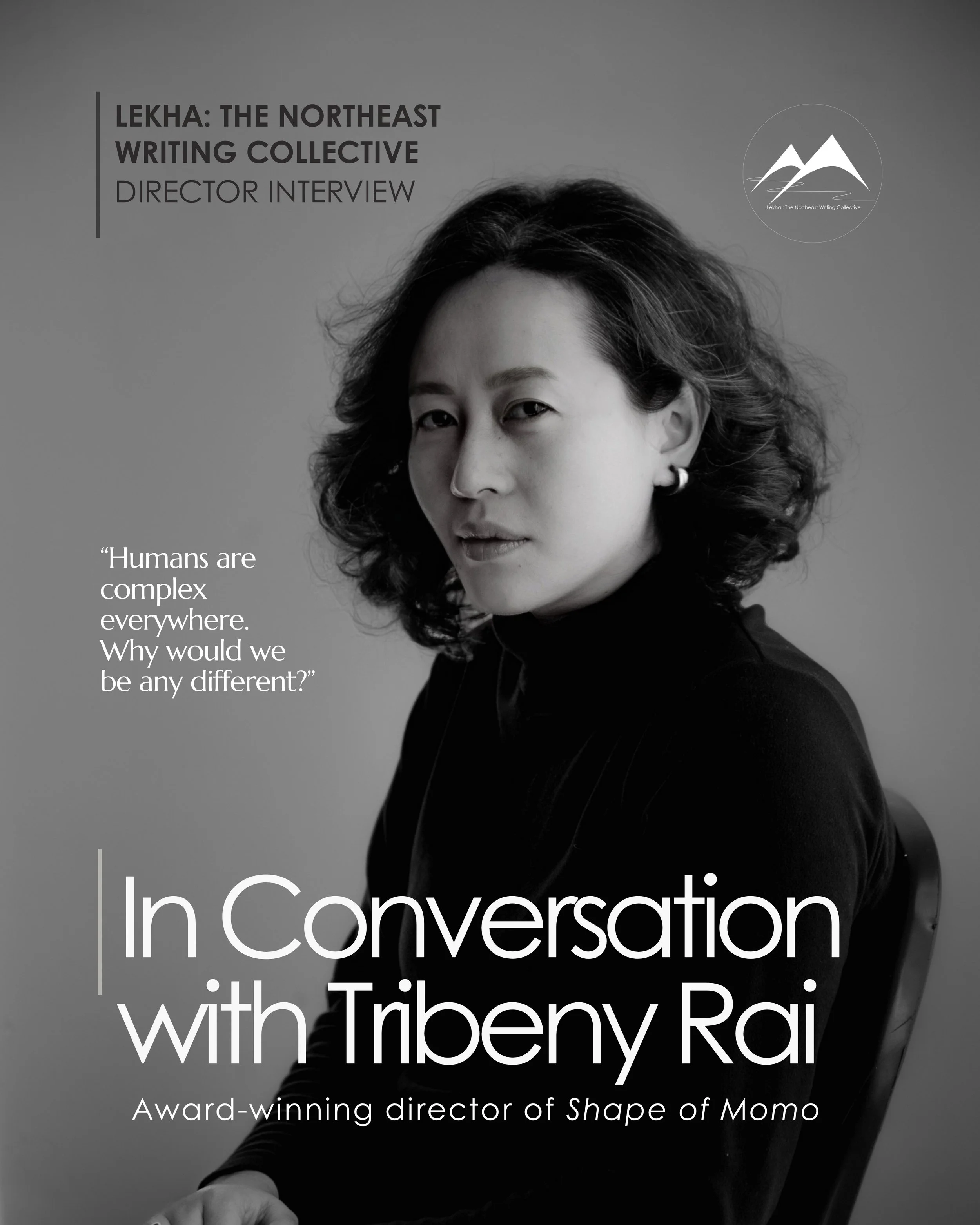
Yana Azaad, lead editor at Lekha: The Northeast Writers Collective interviews Tribeny Rai, award-winning director from Sikkim. Her film Shape of Momo is the winner of the Grand Jury Prize Indian Film Festival of Los Angeles and double-winner at the Busan International Film Festival and many more.
Shape of Momo releases in theatres across India and Nepal on the 29th of May 2026.
Yana: Can you tell us a bit about the process of writing and directing Shape of Momo? How long did the script take to come together? What prompted the idea for you? And what was the process of finding the right collaborators and funders like for you?
Tribeny: The process has been challenging but equally fulfilling. The script took a few years to find its shape. The early drafts were messier and more ambitious in the wrong ways. Kislay, who is the co-writer and producer of the film, brought in a great deal of perspective and objectivity that the script needed. At its core, the film grew out of the experiences of women around me, and my own.
The team consisted mainly of SRFTI and FTII alumnas, and working with collaborators who share a similar grounding in cinema and training has deeply benefited the film. Finding the right funders is equally critical. People who believe in your vision and trust the process. In that sense, I am very grateful to have collaborated with Kathkala Films from Delhi, who came on board very early and held that space for us throughout.
Yana: Each character in the film is extremely well fleshed out - not just Bishnu, whose story the film follows most closely, but also her sister, mother, grandmother, and the migrant labourers they employ. What does your character-building process look like? Do you write extensive backstories, draw from observation, improvisation with actors, or discover the characters during filming itself?
Tribeny: Most of it was developed during the writing process itself. Kislay and I drew extensively from day-to-day observations as well as my own experiences. For us, it was very important to develop every character in a way that serves their purpose in the story, while also presenting them with ample dignity. As writers, we didn't take sides; we treated them as real people with real complexities. You may not be able to fully empathise with any one character, and that was deliberately our challenge.
Yana: The film is so funny! The humour is witty, punchy, and unexpected. Any advice you have for those wanting to make their writing more humorous?
Tribeny: Honestly, I am still trying to understand it myself. In real life I have never landed a single joke correctly. I have, however, always had a lot to say and a particular way of saying it, and perhaps that is where it quietly sneaks into the work. I cannot yet fully identify which part of my personality helps develop these moments, but I suspect humour, at least the kind I am drawn to, lives very close to truth. When characters are written as real people in real situations, the funny finds its own way in.
Yana: One of the things that stayed with me after watching the film was how much is communicated through gestures rather than dialogue: the mother covering her daughter with a blanket when a man enters the scene, Bishnu’s disappointment when Gyaan doesn’t take his plate to the kitchen after his meal, the scene of an older woman , running in small circles on her terrace while Bishnu runs outdoors. These scenes made the film extremely relatable to me as a viewer. I wanted to ask about how you cultivate your attention as a creative person: how do you train yourself, as a writer and filmmaker, to notice these small social gestures that many people might overlook? Do you take notes in the moment, or do they come to you when you begin writing the script?
Tribeny: I think one of the most important qualities of a filmmaker, or any artist really, is the ability to be observant in life. That is perhaps why we are the sensitive lot. I feel very deeply about things and people. Some of these moments I write down because I tend to forget them, but mostly they are observations that have stayed with me so deeply that the only way to process them is to express them through this medium. Kislay came to write the script at my place for a long stretch, and many of his own keen observations have also made their way into the film. It was very much a shared act of paying attention.
Yana: Stories from the Northeast that gain attention in the mainland and internationally are often laced with stereotypes: the idyllic village, insurgency, exoticism, and “simplicity.” Further, there is a popular assumption that women in the northeast are more “empowered” compared to those in the mainland. What I loved about Shape of Momo is the way it resists those expectations and instead presents the region with all its tensions, hierarchies, intimacies, and contradictions intact. Was this refusal something you were conscious of in the writing process?
Tribeny: Honestly, this was one of the primary reasons I wanted to make this film. Either someone else tells our story for us, or we tell it ourselves the way they want us to. My friends from film school would often tell me that it must be heavenly to live in the middle of the forests in the hills and write a script. They barely understood the contradictions that fill my tiny village. When people exoticise or simplify our lives, I feel as though they are stripping us of our dignity. Humans are complex everywhere. Why would we be any different?
And this idea of the empowered northeastern woman, of a progressive society. Who decides what is progressive or empowering enough for women? Not them. We do. Am I glad that men in our region treat us as equals? Yes. Should I be grateful for it? No. Because that is simply how the world is supposed to be.
Yana: What filmmakers, writers, books and movies do you find most inspiration from? Is there a book/movie you’d recommend to our readers?
Tribeny: We must watch films from different parts of the world, what we called world cinema back in film school. Those films open a window to a whole new universe. Nuri Bilge Ceylan, Satyajit Ray, and Tarkovsky are filmmakers whose work I return to very often. For aspiring filmmakers, I would strongly recommend Kurosawa's autobiography and Tarkovsky's Sculpting in Time.
Yana: Shape of Momo is in Nepali, and there’s often a perception within the publishing and film industries that regional-language independent work has a very limited audience. Yet your film has travelled widely and won awards nationally and internationally. Did you ever feel pressure to make the film more “accessible” linguistically or culturally? And what would you say to young writers and filmmakers who want to tell stories rooted in their own languages and regions, but worry nobody will listen?
Tribeny: Film festivals are largely made up of cinephiles who have no problem reading subtitles, so I never felt that pressure. The real challenge comes at the point of release. When your language is a minority in the entertainment industry, your market automatically shrinks. But I don't think that should stop us from pursuing our stories.
Growing up, I never saw my people or my world represented on screen. I don't want the next generation to have to carry that same feeling of alienation. That, more than anything, is why this film had to be made in Nepali and no other way.